
THE WEEKLY INTERVIEW: MEW VOCALIST JONAS BJERRE

weekly 2

It’s been about six years since you toured the States. Why such a long break? It was a break from everything, really. We toured a lot on [2009 album[ No More Stories…, and the last tour we did took us to Southeast Asia and places like that. We were a little bit spent, because we had been touring for almost two years, on and off, and we decided to have a little break before we started writing the next one because we never did that. We used to live together, too, so it was just full-on band—everything was the band. Everyone wanted to pursue other things for a while, things that we had thought about doing but never had the time to do. [Then] we played South by Southwest this year, and it was such a great experience and really made us feel like it would be great to come back. We’re super excited to come back to the States. We’re really enjoying touring these days.

You guys are obviously talented musicians, but unlike some other progressive-rock bands, your music remains accessible. How do you keep from overindulging on the technical side? We obviously enjoy some prog-rock, but I don’t like prog-rock when it becomes too virtuoso, when it’s like, “Hear how many notes I can play in a minute.” That doesn’t really connect with me in any way, that just becomes showing off and we’re not interested in that at all. We’re interested in conveying ideas, figuring out new ways of writing and expressing something that’s important to us. That is the drive we have.

Do you struggle at all to re-create the produced music live? I don’t think we do. It’s definitely different, because we can’t layer as many things. But on this record, our producer, Michael Beinhorn, was quite adamant that we make the songs work just in the practice space, and we did that in pre-production. We didn’t jam them out; they were written with different styling points, so it was important to him. Also, we had just gotten [bassist] Johan [Wohlert] back in the band—we had the rhythm section back to the original—and he wanted to explore that as much as possible in the music. We really tried to make it a band album, to make it sound like a band playing, and I think we succeed quite well. I don’t think it is that different when we play live. It’s obviously a bit more raw, but it’s not like a totally different kind of scenario.

Do you have to choose which instruments are going to be performed live? We have to do that all the time. And also, we can’t do as many harmonies as on the album but we seem to be quite good at getting around it in ways. Nick [Watts] our keyboard player who we’ve played with for many years, he is very busy when we play live; he does a lot of stuff—backing vocals, guitar and a lot of synths and chords and little counter-melodies—and sometimes he’ll play one of the harmonies on the piano instead of singing it. It kind of comes together in the same way, just slightly different.

Did it take you guys a while in the early days to really be satisfied with your live sound? When we first started out, I think we were just very excited to be able to make a lot of noise (laughs). It was more about playing really loud and having the amps cranked up.

When we first started the band we already were friends, and we were doing stuff together creatively, but the idea of forming a band came about when this whole wave of bands like Nirvana came out, which led us to discover Dinosaur Jr, My Bloody Valentine, Sonic Youth and stuff like that, which was more like alternative-rock music. Before that time, we had grown up with ’80s pop music, so I think we started out maybe slightly mimicking some of the bands we liked at the time, and ever so slowly our own kind of unique weirdness crept into the mix. I think when we did [2003’s]Frengers album, that’s when we really started thinking about sonics and how to convey it live. Before that we were too caught up in different things to even think about that. Back then, you just played small gigs, small venues, and you didn’t have your own sound guy, so whoever was there just had to make sense of it.

Mew has been a band since 1994, so more than 20 years. What’s left to accomplish musically? I think it’s about trying to make the most natural album you can, where it just feels completely unhindered in a way. There are always passages you just work too much on. We love working out all the details, but the really magical moments are the ones that come about where you don’t have any idea where they come from—you just grab it out of the air. If we could make an entire album like that, that would be the goal. I don’t know if it will ever happen. I think there is always going to be some hindrance to reach that point.

How important is it to you as a songwriter to blaze new musical trails? It’s very important. I think if you reach a state where you say, “We’ve figured it out; we should just keep doing this,” then it’s kind of just repeating yourself or planting the flag and saying, “This is as far as we’ll be exploring in the world of music.”

I think it’s important to us that it can’t be too easy for us. We have to keep challenging ourselves in terms of where we can take the songs and where we can take music and trying something new every time. I don’t really understand bands that just aspire to sound like The Rolling Stones or whoever. The Rolling Stones already did it. It’s not that you have to reinvent music entirely, but if you can contribute something new, that is what any band should aspire to do.

What is the current music scene like in Scandinavia? It’s pretty interesting. It’s grown so much in the time I’ve been alive. When we started out as a band there were a lot of interesting things going on, but it was so hidden in the underground, because the bands who got signed were signed by people who didn’t really understand what they were doing. They would sign bands that sounded like something that happened in the U.K. four years before, so it was very derivative of the U.K. scene.

Now, it feels like bands really dare to be themselves and maintain their own uniqueness. When we started out it was kind of unheard of for a Danish band to even tour in America. We didn’t have like what they have in Sweden, a long history of successful international bands. We never had ABBA or anything like that, so the music scene was little bit weak. But I think it is just so much better now—a lot of great bands coming out of Denmark and Scandinavia as a whole.

Weblink: http://lasvegasweekly.com/ae/music/2015/sep/16/the-weekly-interview-mew-vocalist-jonas-bjerre/
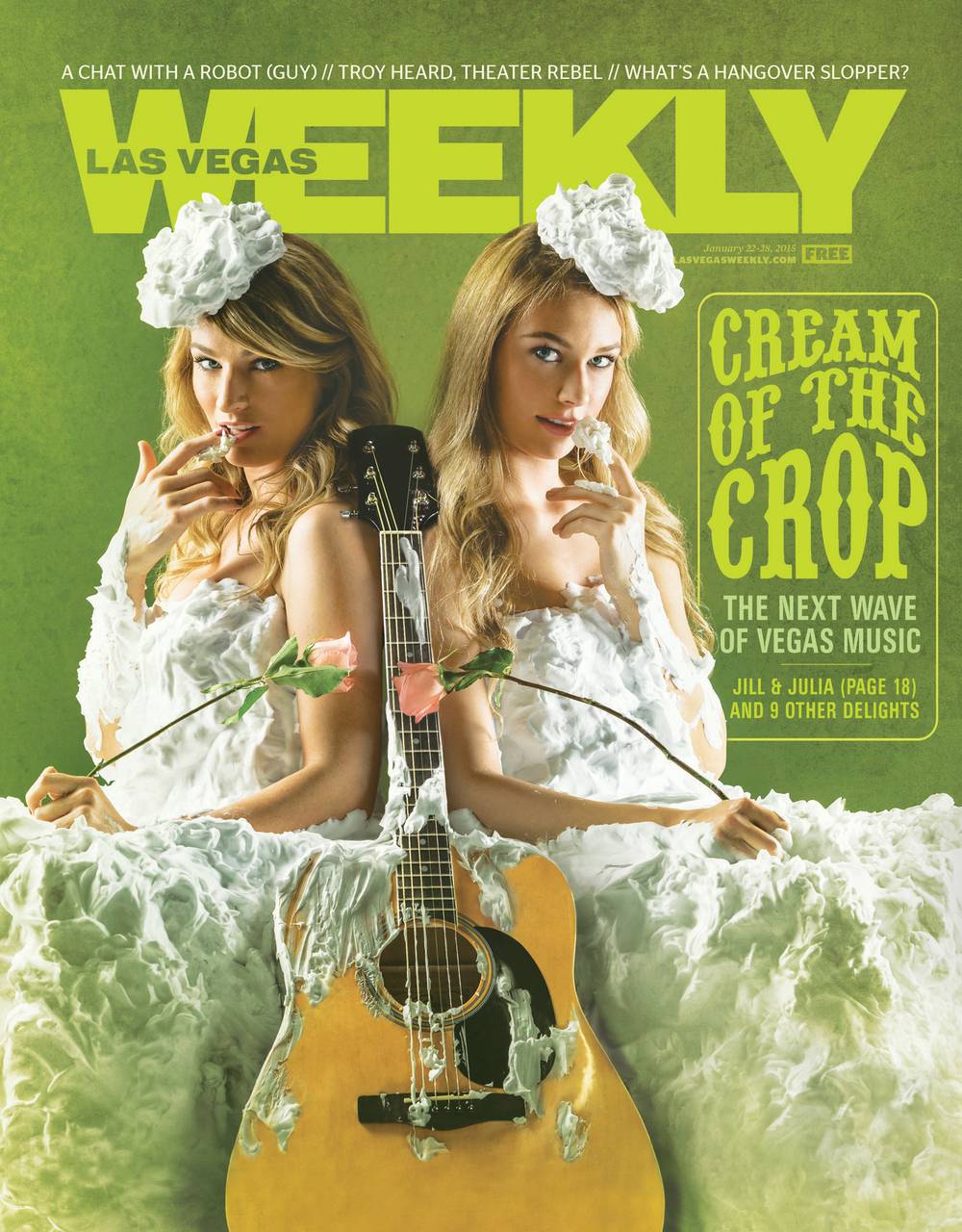
My First Weekly Cover Story – The Next Wave Of Vegas Music

LVW_cover_1_22_t1000

Very proud to contribute the feature to Las Vegas Weekly’s coverage of emerging artist within the city’s local music scene.

JILL & JULIA

Caesars Palace headliners and NFR week aside, Las Vegas has never been famous as a country-music stronghold, so sister duo Jill & Julia’s decision to move here instead of Nashville when relocating from Indiana seems … odd. “People are always asking us why,” 23-year-old Julia says, “but the truth is, Las Vegas is very kind to country music, and there’s a big market here.”

The pair draws frequent comparisons to such favorite female artists as Miranda Lambert and Kacey Musgraves. And like Musgraves, the sisters write and perform their own songs, most of them acoustically driven ballads with strong lyrics and catchy melodies.

Location doesn’t seem to have impeded Jill & Julia’s rapid ascent over the past year and a half, which has seen them sign with Lamon Records, release a self-titled EP, perform at Vegas’ Route 91 Harvest Festival and complete a successful radio tour promoting single “Wildfire.” The duo is poised to release first full-length album Cursedin February, describing the project as darker than previous work, lyrically and melodically. “I don’t think we used any major chords on it,” 18-year-old Jill says.

The sisters insist that for them, success simply means the chance to play music full-time. Judging by their sound and momentum, a more exciting future isn’t a stretch.jillandjulia.comChris Bitonti

Web link: http://lasvegasweekly.com/ae/music/2015/jan/22/next-wave-vegas-music-10-acts-local-band-hear-year/

THE WEEKLY INTERVIEW: INCUBUS DRUMMER JOSÉ PASILLAS

weekly 2

The band’s latest release, Trust Fall (Side A) is a four-song EP. Why did you choose to release an EP versus a full album? It’s just experimenting with how we create music and put out music. We’ve been doing the same thing for 20 years now—we write a record, put out a record, tour behind the record—and eight records later, we thought we’d try something different. It almost seems obsolete to put out a full record now; the attention span of the population isn’t there. I’m the same way. [And] we thought putting out a few songs would give us time to go out and tour behind it a little bit and, at the same time, in between tours, write and record music.

The plan was to do a Side B, [but] we’re now talking about putting out a full record. We’re not sure. We do have a lot of material that’s being written and recorded, so we’ll finish that after this tour. There’s a lot of options, which is a good thing.

Lots of bands are putting out music in smaller doses these days, but I wonder if it makes a big enough splash to rise above the noise. There’s no guaranteed way of anything anymore. It’s really just if radio catches a song, and for us “Absolution Calling” did well. We’re doing really well with ticket sales, better than we’ve done ever, which for not being on tour for a really long time is kind of miraculous.

The four songs on Trust Fall have four very different sounds and styles. Was that intentional? Those were just the four songs that we worked on the most, and we thought it was a good snapshot of where we’re at. We like to be dynamic within our records, and one song to the next is usually pretty different, just like one record to the next is usually pretty different. I would say that the jumps between [these] songs may be a little more drastic, but it’s just sort of what came to us.

Will the next release will be related conceptually? It’s really hard to tell. The music that I think will be on the next installation will be different for sure. We’ve got a lot more mellow stuff that we’ve written, and a handful of more frenetic stuff, so to see where it’s gonna go will be interesting. As soon as we get back, in September, our goal is to hone in on maybe 10 or 12 songs and finish them and see how it goes.

You’re doing two nights here over Labor Day Weekend. Are you planning anything special to change up the shows? We change up the set from night to night, take each show, see what we’ve done, see what we want to do and make a set before the show.

Are there certain songs you feel like you have to play every night? We’ve got so many singles that have done well that we have to put in a bunch of songs. We could play 22 songs of all singles, but that wouldn’t be any fun for us, because there are so many deeper cuts that we love to play. The hardest thing for us to do is make up a setlist, because you cannot please everyone, and we never do. We just do the best we can.

Incubus has been a band for 20 years. Is it still fun performing, or is it more of a job now? We’re having a great time. I mean, we’ve taken time between records—we take the much-needed rest and then we’re ready to go. The best part about playing in a band for myself is bringing the music to life playing shows. That’s always been our strong point, and we still have a good time and I think when people come see us they can see it. Sure, after four or five weeks of doing it, it does become difficult and tiring and sometimes we’re on autopilot. That’s why we don’t tend to go more than five weeks, because that’s the point where we’re just exhausted.

I also wanted to talk a little bit about the Make Yourself Foundation. Can you tell me what it is and how you’ve been helping out with other nonprofits? We’ve always been asked to help out with all sorts of nonprofits and charitable organizations since we started to do well, and we’ve always helped out when we could. After a couple years we thought we’d concentrate our efforts by starting our own foundation. That’s why we came up with the Make Yourself Foundation, and we’ve been doing it for many years now and it’s been great. Every year, we put money toward this foundation and at the end of the year, we delegate what organizations we want to help out. We pool the money through tickets, merchandise, auctions. At the end of the year, we usually have a big stack, and we sit down as a band and go through it, talk about it and see where it goes.

What are some nonprofits you’ve supported through the foundation? Heal the Bay has always been one. Surfrider Foundation. A lot of environmental stuff, that’s where most of our efforts go. Those are some great nonprofits doing really good work, and we’ll continue to help out however we can.

Web link: http://lasvegasweekly.com/ae/music/2015/sep/02/incubus-drummer-jose-pasillas-interview/

CHELSEA WOLFE’S DARK SONGS TRANSPORT A RAPT CROWD DOWNTOWN

weekly 2

Three stars

Chelsea Wolfe August 27, Backstage Bar & Billiards.

It’s Thursday night, and I’m sweating inside the steaming Backstage Bar & Billiards, surrounded by an anxious, near-capacity crowd as the smell of artificial smoke permeates the room and Chelsea Wolfe takes the stage. Compared to her last time in town, opening for Queens of the Stone Age at the much larger Joint, tonight’s setting is the most intimate you’ll find on her national tour, which kicks off here.

As Wolfe and her band move forward, you feel the weight of the bass pulling your gut as druggy distortion splits your chest like the grind of a rusted transmission. The slow music evokes a dark sadness Wolfe embraces and carries like the modern gothess she is. If you need speed or flash, this isn’t the place; patience and endurance take center stage tonight.

Wolfe’s haunting voice can veer from moaning bellow to angelic siren in a single phrase. Time stands still as she sings, never rushing through a slow burn, letting each crash of the drums resonate and fade as she continues the death-march through her catalog. Aptly titled new album Abyss, the LA-based artist’s fifth since 2010, carries the bulk of the hour-long set. The new songs carry forth Wolfe’s experimentation, fusing goth, industrial, doom and ambience. Her swayable, reflective music plays like the soundtrack to a strange and enjoyable noir film in which we’ve all been cast.

Web link: http://lasvegasweekly.com/ae/music/2015/sep/02/chelsea-wolfe-dark-songs-transport-crowd-downtown/

FIVE THOUGHTS: MASKED INTRUDER AND THE FLATLINERS (AUGUST 26, BEAUTY BAR)

weekly 2

1. Fat Wreck Chords’ 25th Anniversary Tour didn’t stop in Las Vegas, but we’re lucky enough to land one of the better spillover shows at Beauty Bar, pairing rising Fat bands Masked Intruder and The Flatliners on a Wednesday night.

2. Masked Intruder performs music from a self-created genre I’ll call retro-crime-punk—taking ’50s doo-wop tunes and speed-punkifying them, with lyrical topics like burglary, armed robbery, puppy love and general disarray. It would feel super niche if M.I. wasn’t so damn good at it. Songs like “Stick ’em Up,” “Crime Spree” and “25 to Life” are catchy, funny, well-crafted pop that resonates beyond the shtick.

3. “I come from a little town called prison.” The members of Masked Intruder (Intruder Blue, Green, Yellow and Red) never break from their secret, hardened criminal personas, and even sport heavy Brooklyn accents … though they’re from Wisconsin. Their stripper/cop/hypeman Officer Bradford spends the whole show riling up the crowd, instigating dance-offs and sweatily hugging anyone within reach.

4. Heavy-drinking Toronto-area foursome The Flatliners are headlining tonight, but the crowd has thinned out a bit post-Masked Intruder. In contrast, the pit has expanded and intensified, fomented by singer Chris Cresswell’s shrieking yell.

5. Live, The Flatliners surge as a straight-forward punk outfit. What they lose by ditching the ska/reggae style of their recorded work, they more than make up for with velocity and energy.

http://lasvegasweekly.com/ae/music/2015/sep/02/five-thoughts-masked-intruder-flatliners-august-26/

THE WEEKLY INTERVIEW: MELVINS FRONTMAN BUZZ OSBORNE

weekly 2

You played here last as three-piece Melvins Lite. What’s the setup for this tour, and how will it differ sonically? The guys from Big Business are going to open, and then play with us for the rest of the show. With Melvins Lite, we had Trevor Dunn on stand-up bass so we featured that a little bit. Now we have the two drummers, so we let them do a lot. It’ll be great.

Does adding a second drummer make your sound more complex and heavier than usual? That is exactly it. It’s heavier as far as that end of it, drumming-wise, and we can play stuff that’s more complex. Coady [Willis] is a really great drummer, too. You just let them do their thing, sit back and enjoy.

One thing I’ve appreciated in your live performance is that you’re so willing to let songs develop before you really explode into fast parts. I’ve heard your music described as being run over by a big, slow truck. Would you agree? There are certainly aspects of that in what we’re doing, but it’s not all slow. Our tempos vary drastically from super-fast to slow as well. I think it’s all over the map—really dynamic. For some reason, over the years people have always picked up on this slow thing. I don’t know why.

In the last couple of months you’ve released the Chaos as Usual split with Le Butcherettes, and guested on the new Brothers Collateral album, toured twice and Kickstarted a documentary. Do you ever slow down? Well, the documentary isn’t us—that’s done by two other guys, but we’re endorsing it. I wouldn’t want to be involved in doing a documentary myself. We do a lot, but you’re also comparing it to a vast world of musicians that are by and large not very active (laughs). Most bands do a record, what, every three years? That means you have to come up with 8-12 songs in three years—wow! (laughs) How do they manage? That means you could work on one song a month and still have plenty of time.

Is that part of your creative attitude, that you could always be doing more? I’ve talked to my wife about stuff like this … I think maybe it’s that I’m not working hard enough, that there’s too much sloth going on, and she just looks at me and tells me I’m going crazy. I think it’s good, though; I really wouldn’t want to operate any other way, personally. I’ve always felt I have room for whatever I want to do.

You also spend a ton of time on the road. How do you keep from burning out? It’s part of the deal. If we can’t play live, then it’s difficult to make this work. We do it from that perspective and take it from there.

But it’s still enjoyable? Not always; not every day is enjoyable, but when you’re doing something as much as we do, the odds of every day not working out perfectly go way up (laughs).

Do you have it down to a routine now? There is nothing routine about going on the road. (laughs). There’s always some new thing, some fresh hell to mess you up, but you just soldier through it. I mean, I play with guys who are pros; they know what to do. I go out there to play as good as I can every single night. It’s part of the deal; I’m not afraid of it. Some people don’t want to do it, and that’s fine—don’t do it; that’ll just leave more room for the rest of us.

I noticed you’ve become a Major League Baseball correspondent on Fox Sports. Who do you like at this point? I was a correspondent with them until they just quit calling me. I don’t know what happened there. I did it for quite a few weeks, and then this thing with deflated footballs happened and they had no time for me. I just never heard from them again.

Who do I see as doing well? At the beginning of the year, I thought Seattle and Cleveland were going to do really good, and I thought the Dodgers were going to do really good. So far, the only one that’s true is the Dodgers. I think it’s really up in the air. Clearly, St. Louis has the best record in baseball, and I like St. Louis fine but I’m really getting bored of them and the Giants in the World Series or in contention for it. I’m not as interested in American League baseball; I think it’s boring.

Because of the designated hitter? Yeah, I hate the DH. They gotta get rid of it; it changes the whole aspect of baseball. There’s always people who’ll say, “Who wants to watch a pitcher bat?” We’ve got guys batting well under .300 on the Dodgers—how exciting is that to watch? It should be part of the strategy, and it leaves rooms for pinch hitters, who are also utility guys. I think it’s just better baseball.

Do you ever bet on baseball? No, the only thing I bet on is golf, and that’s when I’m betting on my own ability to play. I’ve helped other people place bets on baseball, but I don’t particularly care.

Web link: http://lasvegasweekly.com/ae/music/2015/aug/26/interview-melvins-frontman-buzz-osborne/

WITH GRACE AND STAMINA, DAWES KICKS OFF THE BUNKHOUSE SERIES AT SAYERS CLUB

weekly 2

Fiour stars

Dawes August 8, Sayers Club at SLS.

“May all your favorite bands stay together.” It’s a fitting toast from Dawes frontman Taylor Goldsmith on Saturday night, echoing the title of the LA folk-rockers’ latest record and tapping into the grateful energy of a band and a crowd that almost missed each other.

After the July closing of Downtown’s beloved Bunkhouse, Dawes and a couple dozen other scheduled shows were suddenly homeless. But most of them will go on under these shimmering lights in the SLS’ stripped-down Sayers Club, saved from the fire as the Bunkhouse Series (of which Las Vegas Weekly’s parent company, Greenspun Media Group, is a sponsor).

The room is full for this kickoff performance, with around 200 attendees. But considering that Dawes’ last Vegas show happened on Life Is Beautiful’s main stage—and that they just played Bonnaroo—it feels like a secret treat to see the Americana outfit in this intimate setting. Sayers Club has dropped its ultra-lounge persona for a pure music-hall experience, the open floor snugging right up to the stage.

Dawes is generous with familiar favorites, from “Time Spent in Los Angeles” to the set-staple cover of “Fisherman’s Blues” to the band’s most recognized tune, “When My Time Comes.” But newest album All Your Favorite Bands is the dominant flavor, played nearly in its entirety with an easy confidence. Maybe that’s because it was road-tested and recorded almost entirely live. It’s a tribute to the abilities of these musicians that they’re still able to reinvent the songs so compellingly.

Songs are sped up, jams are extended and the signature Dawes sound of a clean, bright guitar pushed just to the brink of distortion sweeps through the crowd during the marathon two-hour set. Brothers Taylor and Griffin Goldsmith slay with their harmony, voices fusing and compounding and marking the evening with a memorable tenor reminiscent of LA bands gone by.

With the success of opening night, it’s impossible not to get excited about the Bunkhouse Series’ upcoming lineup. Getting face to face with groups like Doomtree, Melvins and The Polyphonic Spree doesn’t happen often anywhere, let alone in Las Vegas, where indie rock’s good fight continues.

Web link: http://lasvegasweekly.com/ae/music/2015/aug/12/dawes-concert-review-bunkhouse-series-sayers-club/

THE WEEKLY INTERVIEW: DAWES DRUMMER GRIFFIN GOLDSMITH

weekly 2

Your songs can be very different live—more jammy, and sometimes a little heavier. Yeah, we’ve always made a concerted effort to extend certain sections and give songs another element live that we don’t necessarily have on the records.

Is that why you recorded the most recent record (June’s All Your Favorite Bands) almost entirely live? Yeah, it has always been a struggle for us to put on the record what we do live, and we’ve always felt that we are at our best as a band in the live setting. The mentality was, let’s go make it sound as live as we can and capture that energy in the studio. That’s how [producer] Dave [Rawlings] records all of his music. We were all facing each other, and we tried creating that vibe that you get onstage. And it seemed to work out.

You also road-tested the songs, right? How did getting to see audience reactions affect the final outcome? There were certain sections that just weren’t hitting live, so we would structure them differently, like the bridge would come after the second chorus as opposed to after the solo, something like that. That kind of experience is invaluable. Even with countless hours of rehearsal, you can’t get what you get playing the song in front of an audience in one show.

Is there a particular song you think really benefitted from that? “Right on Time” definitely came together in that particular way. It became more driving. All of them really benefitted, though.

A lyric from the title track stood out for me: “May all your favorite bands stay together.” Where did that idea come from? [Frontman] Taylor [Goldsmith] had that line for a long time—he was actually singing the chorus for a long time and didn’t know what to do with it. The song was written for a friend, a younger person who was kind of finding their way, this was like a good-tidings-to-you sentiment. Despite what you may experience, how traumatic certain things can be, try to hold onto that element that makes you youthful. If you really unpack it, it’s somebody who’s graduated from adolescence.

Dawes’ lyrics remind me of signature LA artists like Jackson Browne, The Eagles and Tom Petty. Is that the music you and Taylor were raised on growing up in Southern California? We were more raised on soul and Steely Dan, and Bob Dylan to a certain extent. We didn’t really start getting into that stuff until people started making the comparisons. It makes sense, I guess, but when we released our first record that was a common criticism or a common comparison, but I didn’t listen to a Jackson Browne record until I was like 19. I had heard some of his songs, but I didn’t dig deeper into his catalog until we were given the opportunity to meet him and hang out with him. I didn’t develop an affinity for Joni Mitchell or The Eagles until later as well, and I know the same goes for Taylor.

Maybe it has something to do with being raised in LA and the commonality that we all experience as Angelenos. For any artist, where you come from influences your tastes and forms your decisions and aesthetic values. LA is a giant city, yet there’s a certain closeness, and it definitely cultivates a certain type of lifestyle.

Your musical style brushes up against a lot of genres. I’ve seen you on bills that were bluegrass, alt-country, rock, folk. How would you describe it to someone who hasn’t heard you? I usually just go with rock ’n’ roll, but I can see why somebody might want to call it Americana or folk or indie rock. It’s tough for me to say objectively it’s this or that—it’s whatever the listener makes it. But I’m happy we do brush up against all these different genres, because it’s given me opportunity to play with a lot of artists that are very different from one another.

Web link: http://lasvegasweekly.com/ae/music/2015/aug/06/weekly-interview-dawes-drummer-griffin-goldsmith/

THE WEEKLY INTERVIEW: TORCHE BASSIST JONATHAN NUÑEZ

weekly 2

In the wake of the Bunkhouse’s sudden closing on Monday, Sunday’s show has been moved to Backstage Bar & Billiards.

What’s life like for a metal band at your level in 2015? It’s an interesting place to be. You have to put in a lot of hard work, and you definitely have to put in the miles—you have to go on tour and bust your ass writing stuff. … Some bands get lucky, I’m not gonna lie, but I feel if you put in the work, put in the time, you can make a living. We have for some time now.

What sort of goals do you guys have now, having recently released your fourth full-length? To stay on our upward trajectory. The records get better, and as musicians we get better. There’s a certain routine aspect to being in a band, and if we’re off for a very long time we miss it, like certain breeds of dogs—you need to take them out, they need to be walked. I think at a very basic level we’ve been conditioned, like, “Man, I want to get on a stage, I want to play, I want to turn my amp up, I wanna see my friends in other states and visit places.” They’re kind of like work vacations.

New album Restarter sounds like a return to an earlier musical style for Torche. Do you agree? I think it sounds taken back to [2007’s] In Return stuff, heavier and more direct, but I feel like it’s also very current to where we want to be as far as the energy. It’s very true to our live sound.

Did [previous album] Harmonicraft ruffle your fans’ feathers? We tend to do new things and keep ourselves entertained. We have our sound and our identity, but it allows us to revisit or explore an aspect of our sound as opposed to doing the same thing over and over. It’s very liberating and freeing and keeps it very exciting to us to not have limitations on our sound. I feel like Harmonicraft was more sonically tight and energetic in vibe and tone. It was upbeat rock and roll.

It’s been a decade since you released your first album. How has the writing process evolved over those 10 years? We’ve kept the same setup, as far as writing rather quickly, because we’re usually in a time crunch. We have members who live across Florida, and we really have to take advantage of the time we have together. So it’s always really long days, and we usually demo stuff and hear it the next day in order to really let it digest. I feel that over time we’ve really developed a way of working quickly and efficiently both in writing and recording live in the studio. You’re going to have those instances where you hit a wall, so to speak, but I feel that we always work around it together.

One thing I think spans all your records is the band’s pop sensibility, which is notable for a metal band. We all grew up with pop music or even rock and metal stuff that was catchy, that was about the songs. It was all sorts of custom melodies and hooks but that doesn’t mean you can’t get heavy. There’s so much you can do while still keeping it memorable, and that’s something that attracts us.

And except for a few outliers, your songs are usually pretty short, too. Is that intentional? Honestly, we try to let the music come together on its own. It’s very basic songwriting at first, and we very much let it roll. Its not in us to sit there and say, “Okay, for this song we want a super heavy Ramones-type part that goes into this shoegazey wash part that goes back around and does this Sabbath thing.” For us it’s like, “Hey man, here’s a riff.” And if people like it then we’ll jam with it. A lot of the stuff is done on the spot, and some of the stuff gets down to the wire.

Web link: http://lasvegasweekly.com/ae/music/2015/jul/22/weekly-interview-torche-bassist-jonathan-nunez/

ON THE EVE OF ITS FINAL GIG, THE VERMIN LOOKS BACK ON TWO DECADES IN VEGAS

weekly 2

Over 20 years, a handful of records and countless shows, no act has come to embody the Vegas punk scene quite like The Vermin. But nothing good can last forever, and the band’s hilarious, offensive and always-entertaining run ends July 3 with a final performance that shares its name with the release of a new retrospective album, The Vermin Must Die. Singer/guitarist Dirk Vermin, bassist Rob Ruckus and drummer Gerry “Turbo” Proctor look back on two memorably drunken decades in the desert.

THE SHOWS

Turbo: “You grow up listening to Ill Repute, and next thing you know you’re playing with them or Doctor Know or Youth Brigade, or any number of great punk bands from back in the day. … We even got to play with Sylvain Sylvain from The New York Dolls.”

Ruckus: “The first Las Vegas Shakedown at the Orleans—we played with everyone from The Dictators to Guitar Wolf and Wayne Kramer from MC5, an absolutely amazing lineup of bands. All the New York shows, the last LA show we did with Adolescents and 7 Seconds and Channel 3. All the shows with TSOL and Agent Orange.”

Vermin: “Opening for TSOL, as drunk as I’ve ever been onstage. Turbo had to tune my guitar, and it didn’t help. We got to open for Fear twice. One show I remember we were great; the other show I do not.”

THE MOMENTS

Ruckus: “Getting to play for Timothy Leary, who came to see us at the Double Down right before he died. We sat and talked for a few minutes, and then I went on. He lasted about four songs, came up, hugged me and said, “You guys are very entertaining, but you are very loud and I must now leave.”

Turbo: “One show where Ruckus threw his bass at me from the back of the bar at the Double Down. It was spiraling toward my head, and then it did this weird Bruce Lee thing and went sideways and landed perfectly on his amp and my drum head. It was, like, bionically weird, and everyone at the bar was like, “Whoooaaaa!”

Vermin: “At one time we did a weekly gig at the Wet Stop—that’s where we honed our chops and got our stage shtick down. For a weekly show you have to stay on your toes, and the three of us have big mouths, never at a loss for words. But it was tough; it was Wednesday night. I don’t miss it at all.”

Ruckus: There were times at Calamity Jayne’s where I used to do this thing called the beer fountain, where I’d put a full can of beer in my mouth and blow, and it would make 12-foot fountains on each side. I did this one night, and there happened to be a local motorcycle gang up front, and I doused them. One of them jumps onstage and puts a knife to my throat. I finished the song and handed him a shot of whiskey as an apology, and then the guy took the knife from my throat.”

HOME BASE

Vermin: “Double Down. I mean, that’s home. I never feel more comfortable onstage than when we’re at the Double Down.”

Ruckus: “There were so many drunken nights there where just anything would happen. Usually, I would end up naked by the end of the night. Until we got the TV show [Bad Ink], every single show I would end up naked by the end. Then we went on TV, and I was told I couldn’t do it. Now that I’m not on that channel, I can do it again for the last show (laughs).”

THE LEGACY

Turbo: “When there wasn’t a scene in Vegas, The Vermin was the scene. Bands would come, and bands would go. And who’s still standing? The Vermin. But we’ve got all these great bands and a scene that’s thriving now.”

Vermin: “Obnoxious. Your mother hated us, and your sister wanted to f*ck us (laughs). Something like that. We were just that punk band. When other bands would play with us, if we didn’t pick on them they felt like they hadn’t arrived.”

Turbo: “We were the band where punk rock meets pro wrestling. We were the punk-rock Rat Pack, and we had that title for a really long time.”

Web link: http://lasvegasweekly.com/ae/music/2015/jul/01/final-gig-vermin-looks-back-two-decades-vegas-punk/